Web WEB-10 · Nov 2026
¡Vamos!: an app to learn Spanish
A mobile web app in the spirit of Quizlet, built for a student I teach Spanish to: vocabulary, conjugation, grammar, reading and dictation, generated from my own lessons, with progress tracking.
AThe context
I teach Spanish to a final-year vocational high school student. Between lessons, she needed to practise on her phone with exactly what we cover in class. ¡Vamos! takes my worksheets and exercises, written in LaTeX, and turns them into games. On my side, I can see what she has understood and what needs reviewing.
BWhat I did
- Automatic extraction of the vocabulary (648 words) and the 32 conjugation tables from my LaTeX lessons, with a Node.js script
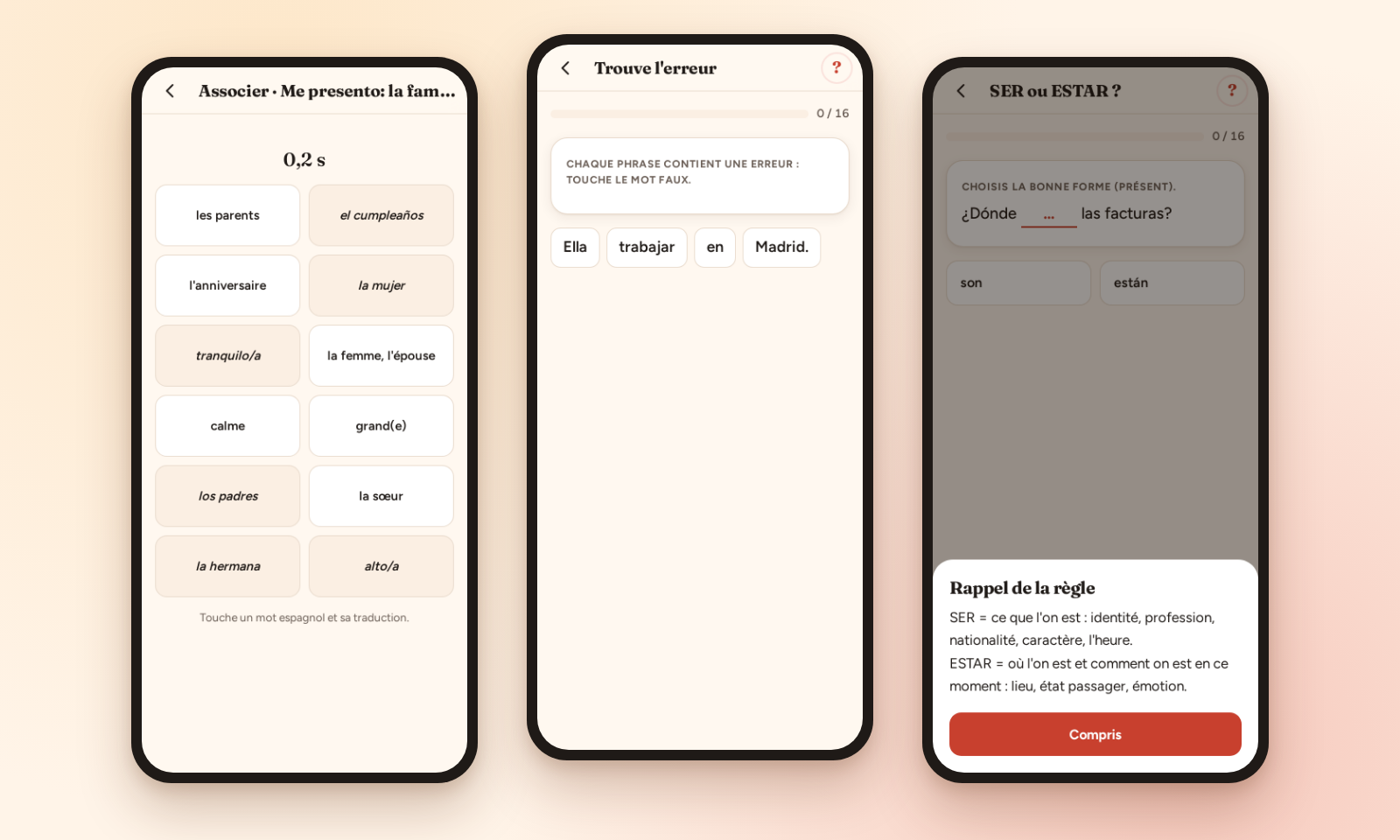
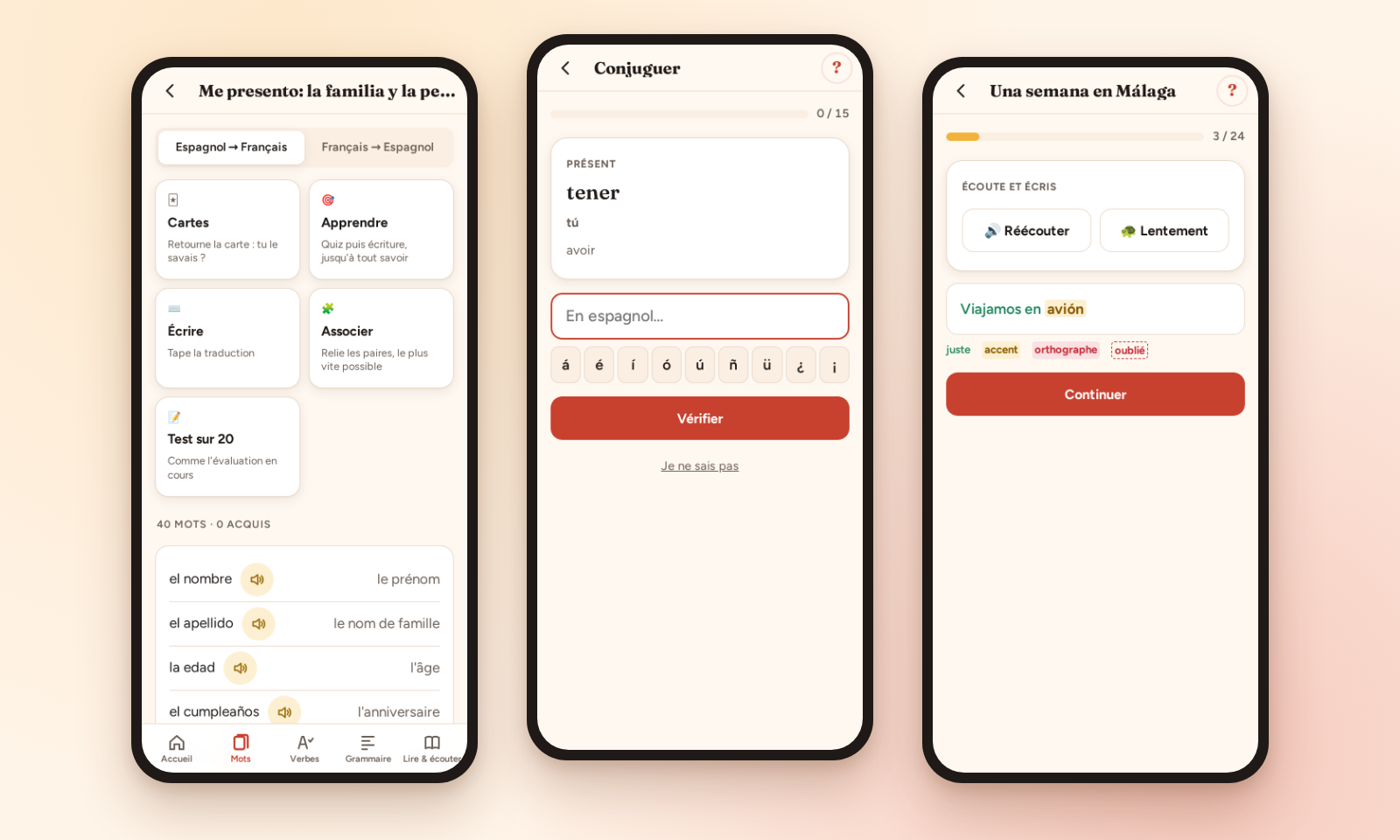
- Five ways to learn a word list: flip cards, a “Learn” mode (quiz then writing, until everything is known), writing, a timed matching game and a test out of 20
- Spaced repetition (Leitner boxes): a word answered correctly comes back the next day, then a few days apart
- Tolerant but demanding answer checking: accents matter (trabajo ≠ trabajó), both genders and variants are accepted
- Dictations read aloud by the phone's speech synthesis and corrected word by word, using a longest-common-subsequence alignment
- Progress tracking: answers are sent in batches to a small PHP and SQLite server, even after a network outage, and I review them in an admin panel protected by a password and two-factor authentication
CThe challenge
The trickiest part was checking typed answers: “soltera” had to be accepted for soltero/a, or “l'épouse” for “la femme, l'épouse”, while a missing accent, which changes the verb tense, had to be rejected. For dictations, the app also had to work out which written word matches which expected word when the student skips or adds some: a word-by-word alignment tells accents, spelling and missing words apart.
DIn pictures